Azoximer bromide included in updated clinical guidelines on acute respiratory viral infections in children
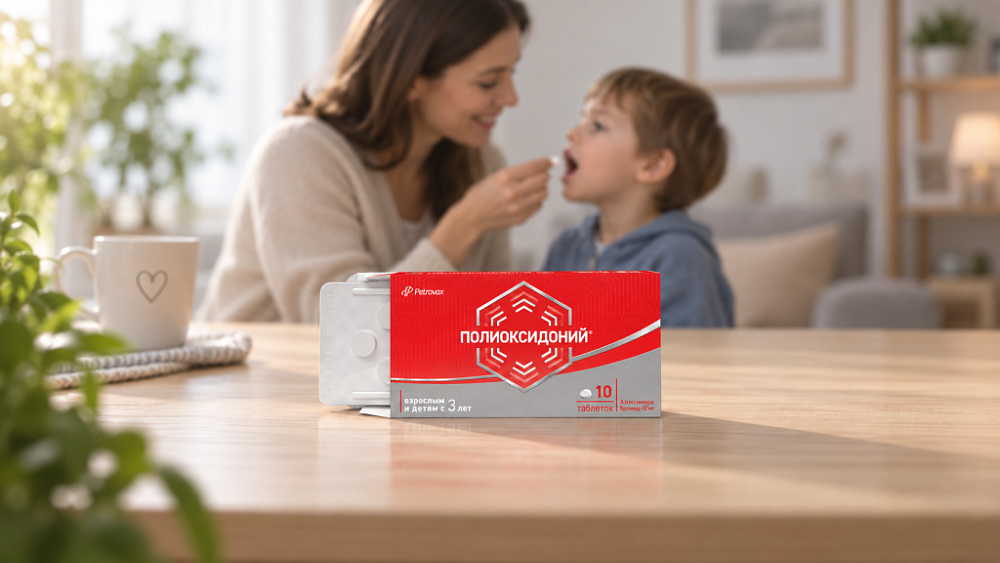
The Russian Ministry of Health has updated its clinical guidelines for the treatment of acute respiratory viral infections (ARVIs) in children. The document revises approaches to pharmacological and symptomatic treatment, including the option of using immunomodulatory medicines. Azoximer bromide (Polyoxidonium®) is among the agents listed, with experience of its use in the treatment and prevention of ARVIs described in a number of scientific publications.
The pediatric clinical guidelines “Acute Respiratory Viral Infection (ARVI)”[1] were developed by the Union of Pediatricians of Russia, the Interregional Association for Clinical Microbiology and Antimicrobial Chemotherapy, and the All-Russian Public Organization “Russian Society of Emergency Medical Care”. The updated document was published on September 2, 2026.
The new guidelines describe ARVI as “a mild, self-limiting illness that does not require antiviral therapy in most cases”[1]. The updated edition pays particular attention to children with recurrent respiratory infections. For these children, it is especially important both to treat each new episode promptly and to reduce the risk of subsequent complications. Children are included in this group based on an increased frequency of ARVI episodes within a year.
Selective prescribing of medicines in the “Immunostimulants” class is recommended for these children to prevent recurrent infections of the ear, nose and throat (ENT) and the respiratory tract. The list includes azoximer bromide (Polyoxidonium®), which helps reduce the frequency of ARVI episodes and bacterial complications, as well as the need for antibiotic therapy.
“Preventive use of azoximer bromide rapidly normalizes markers of local immunity in the upper respiratory tract mucosa: lysozyme and secretory immunoglobulin A (IgA). This positive effect on local immunity persists for at least 3.5 months after preventive treatment, providing the protection children need,”
The inclusion of immunomodulators in the clinical guidelines is supported by evidence. Clinical trials indicate that preventive use of azoximer bromide in children prone to recurrent illness helps reduce the frequency of ARVI episodes by half[2]. A meta-analysis of five studies involving 542 children aged 3–18[3] demonstrated that azoximer bromide, as part of comprehensive treatment for respiratory infections, helps reduce the severity of infection and associated inflammation and has a positive effect on immune mechanisms. Its use is also associated with a lower incidence of bacterial complications, including otitis and sinusitis, and a reduced need for antibiotic treatment[4].
Overall, the updated guidelines reflect a trend toward more personalized treatment of ARVIs in children. They provide for the choice of treatment to be tailored to the clinical situation, age and coexisting conditions, including signs of immunodeficiency. Including immunomodulators in the prevention section gives pediatricians more options while maintaining a balanced approach in which these medicines are prescribed only for clear indications and only to patients who need them.
About Polyoxidonium
Polyoxidonium® (azoximer bromide) is an original medicine developed through years of research by Russian scientists. It combines immunomodulatory, detoxifying, antioxidant and moderate anti-inflammatory effects. Its immunomodulatory mechanism of action is based on a direct effect on phagocytic cells and natural killer cells[2].
This is particularly important during infection, the course of which is determined by both pathogen activity and the nature of the body’s immune and inflammatory responses. By acting on innate immune mechanisms, azoximer bromide helps produce a balanced response to infection.
Polyoxidonium® therefore does more than stimulate individual immune parameters. Its immunomodulatory effect helps create the conditions for innate immune cells to function appropriately, while its detoxifying properties complement this mechanism by helping reduce the toxic burden during infection.
The medicine helps combat both viruses, despite increasing pathogen resistance, and the systemic toxic effects of infection, which may manifest as fever, headache and muscle weakness and may contribute to complications.
Its high-molecular-weight structure gives azoximer bromide pronounced detoxifying activity and enables it to act on the pathogenesis of infectious diseases[3], distinguishing it from other medicines in this class. Polyoxidonium® binds toxin molecules and removes them from the body. It also inhibits the formation of neutrophil extracellular traps, structures that sustain inflammation and damage tissues when produced in excess. This mechanism helps both relieve symptoms and reduce the burden on the immune system.
The medicine is included in clinical guidelines for the treatment of ARVIs in adults; guidance from Russia’s Federal Medical and Biological Agency on the prevention and treatment of influenza and other ARVIs during the COVID-19 pandemic; the Russian Ministry of Health’s clinical guidelines “Influenza in Adults”; the Ministry’s interim guidance on COVID-19; and interim guidance on the treatment of ARVIs during the COVID-19 pandemic.
References
1 Clinical guidelines. Acute Respiratory Viral Infection (ARVI). 2026. (In Russian)
2 Kharit S.M., Galustyan A.N. (2017). Azoximer bromide: a safe and effective medicine for the treatment of acute upper respiratory tract infections in children. A review of the results of phase II and III randomized, double-blind, placebo-controlled clinical trials. Pediatrics. Consilium Medicum. (2):55–61. (In Russian)
3 Karaulov A.V., Gorelov A.V. Use of azoximer bromide in the treatment of respiratory infections and associated inflammation in children: a meta-analysis of controlled clinical trials. Journal Infectology. 2019;11(4):31–41. (In Russian)
4 Bulgakova V.A. Immunomodulators for the prevention and treatment of acute respiratory infections: efficacy of azoximer bromide. Terapevticheskii Arkhiv. 2014;86(12):92–97. (In Russian)
An innovative drug for the immunotherapy of triple-negative breast cancer registered in Russia