An innovative drug for the immunotherapy of triple-negative breast cancer registered in Russia
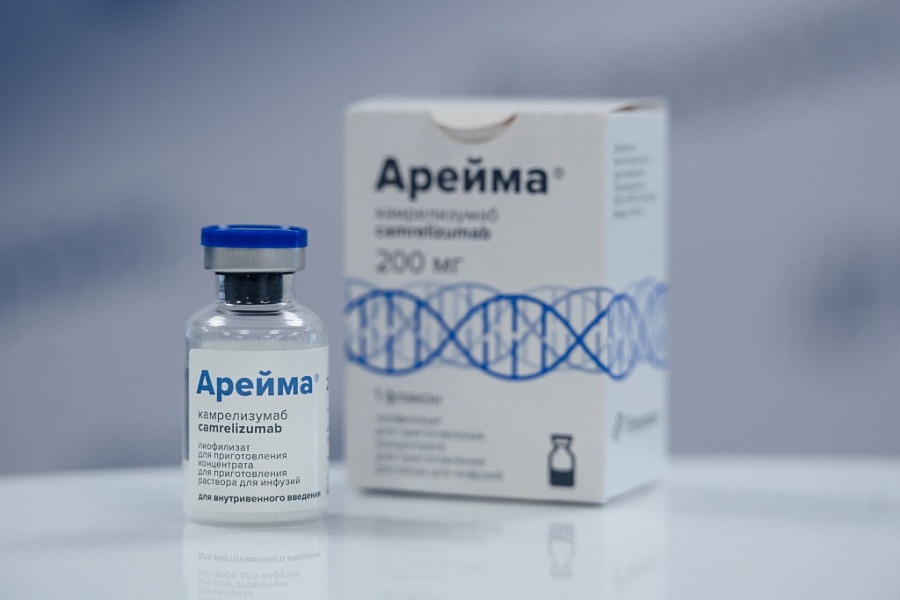
The Russian Ministry of Health has registered the PD-1 inhibitor Areima® (INN: camrelizumab) for the treatment of triple-negative breast cancer (TNBC). This is the first neoadjuvant immunotherapeutic option in Russia for treating a highly aggressive subtype of breast cancer that occurs more frequently in women under 50 years of age. It will be used in combination with chemotherapy at the preoperative stage to improve the pathological response rate and the long-term prognosis of patients[1]. The drug is manufactured by Petrovax Pharm in partnership with the N.F. Gamaleya National Research Center of Epidemiology and Microbiology (N.F. Gamaleya NRCEM) through a full production cycle, including synthesis of the active substance.
Triple-negative breast cancer is considered one of the most dangerous forms of the disease: it is characterized by a high risk of early recurrence and an unfavorable prognosis. Each year in Russia, about 12,900 women are diagnosed with it, predominantly of working age. Approximately 10,000 cases are detected at stages II–III, when preoperative immunochemotherapy can significantly improve the disease prognosis[2], [3]. Triple-negative breast cancer affects young women more often than other subtypes. Among patients aged 15–39 years, it accounts for 19.1% of breast cancer cases[4]. This is why improving treatment effectiveness even before surgery is of particular importance. Successful preoperative therapy helps to better control the disease and reduce the risk of its return, giving women a greater chance to return to their usual lives — to raise their children, work, and not think about the disease.
Until recently, only chemotherapy and surgical treatment were available to Russian patients with TNBC.
The new indication allows camrelizumab to be used in combination with chemotherapy — including taxanes, platinum agents, anthracyclines, and cyclophosphamide — as neoadjuvant therapy, with subsequent continuation of the drug as monotherapy after surgery in patients with early or locally advanced TNBC.
Areima® is already used in Russia for the treatment of nasopharyngeal, esophageal, and lung cancer. The drug is included in the Essential Drug List (EDL) and in the RUSSCO practical guidelines for the treatment of esophageal[5], nasopharyngeal[6], and lung[7] cancer. In August 2026, camrelizumab was included in the clinical guidelines of the Russian Ministry of Health for the treatment of nasopharyngeal cancer (nasopharyngeal carcinoma)[8].
In addition, an Expert Council unanimously supported the inclusion of camrelizumab in Russian clinical guidelines as a neoadjuvant immunotherapy option for early and locally advanced stage II–III TNBC[9]. This was based on the results of the international Phase III CamRelief study, published in JAMA. The study showed that adding camrelizumab to standard chemotherapy increases the rate of pathological complete response (pCR) from 44.7% to 56.8% (a pCR gain of 12.2 percentage points)[1].
According to clinical and economic modeling, the use of camrelizumab as neoadjuvant therapy in patients with TNBC could potentially prevent up to 648 premature deaths annually and preserve 21,000 life-years, equivalent to nearly 19,000 quality-adjusted life-years (QALYs)[9].
Given the high prevalence of TNBC among women of working age, preventing recurrences and premature deaths also carries socioeconomic significance. According to a pharmacoeconomic study, the use of camrelizumab makes it possible to reduce GDP losses by an average of RUB 2.44 million per patient (based on a GDP-per-employed-person figure of RUB 2.87 million in 2025)[4], [10].
Areima® is manufactured by Petrovax Pharm in partnership with the N.F. Gamaleya NRCEM through a full production cycle, including synthesis of the active substance. Localizing production ensures a stable supply of the drug to Russian patients and helps improve the accessibility of modern immuno-oncology therapy.
1 Chen, Li et al. “Camrelizumab vs Placebo in Combination With Chemotherapy as Neoadjuvant Treatment in Patients With Early or Locally Advanced Triple-Negative Breast Cancer: The CamRelief Randomized Clinical Trial.” JAMA vol. 333,8 (2025): 673–681. doi:10.1001/jama.2024.23560 2 Fayaz S et al. Triple negative breast cancer: 10-year survival update of the applied treatment strategy in Kuwait. Gulf J Oncolog. 2019;1(29):53–9. 3 Loibl S, André F, Bachelot T, et al. Early breast cancer: ESMO Clinical Practice Guideline for diagnosis, treatment and follow-up. Annals of Oncology. 2024;35(2):159–182. 4 Keegan TH, DeRouen MC, Press DJ, Kurian AW, Clarke CA. Occurrence of breast cancer subtypes in adolescent and young adult women. Breast Cancer Res. 2012 Mar 27;14(2):R55. doi:10.1186/bcr3156. PMID: 22452927; PMCID: PMC3446389. 5 Tryakin A. A., Besova N. S., Volkov N. M. et al. Cancer of the esophagus and esophagogastric junction. RUSSCO Practical Guidelines, part 1.1. Malignant Tumors 2024;14(3s2):221–242. https://rosoncoweb.ru/standarts/RUSSCO/2024/2024-1_1-12.pdf (in Russian) 6 Bolotina L. V., Vladimirova L. Yu., Dengina N. V. et al. Head and neck tumors. RUSSCO Practical Guidelines, part 1.1. Malignant Tumors 2024;14(3s2):160–182. https://www.rosoncoweb.ru/standarts/RUSSCO/2024/2024-1_1-09.pdf (in Russian) 7 Laktionov K. K., Artamonova E. V., Breder V. V. et al. Non-small cell lung cancer. RUSSCO Clinical Guidelines, part 1.1. Malignant Tumors 2025;15(3s2):90–132. https://www.rosoncoweb.ru/standarts/RUSSCO/2025/2025-1-1-04.pdf (in Russian) 8 https://cr.minzdrav.gov.ru/clin-rec 9 Abstracts of the Expert Council “Current Possibilities and Future Prospects for the Treatment of Triple-Negative Breast Cancer: The Place of Camrelizumab in Russian Clinical Guidelines.” Meditsina (Medicine) journal, No. 2, 2026, pp. 58–64. https://fsmj.ru/62215 (in Russian) 10 Pharmacoeconomic rationale for the use of camrelizumab in the neoadjuvant therapy of triple-negative breast cancer in the Russian Federation. https://fsmj.ru/62315 (in Russian)
Petrovax Pharm supports a documentary project about the lives of people with rare diseases