Localized full-cycle production of a vital oncology medicine launched in Russia
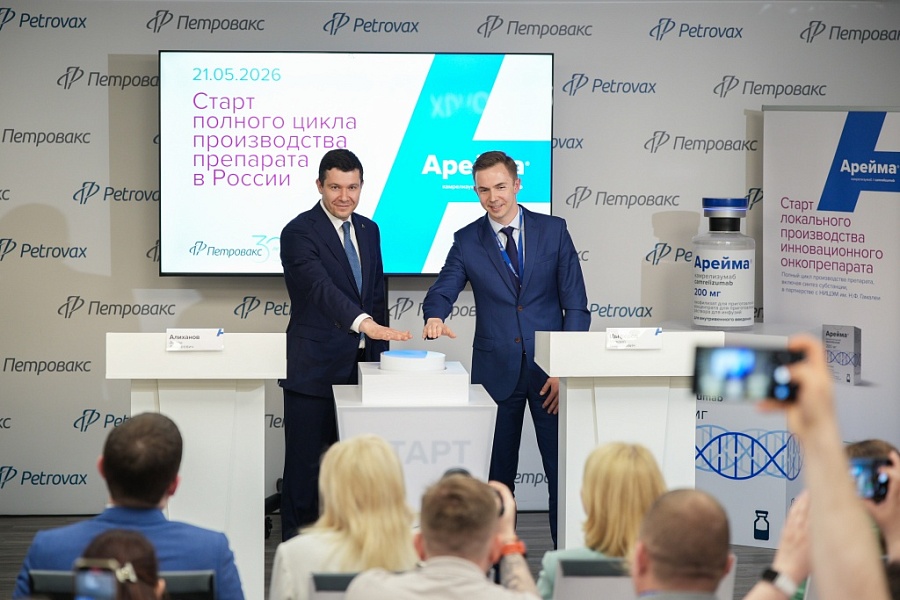
Biopharmaceutical company Petrovax Pharm has announced the launch of localized full-cycle production of the immuno-oncology medicine Areima® (INN: camrelizumab). Localized manufacturing of this PD-1 inhibitor, offering clear advantages over other medicines in its class, will significantly reduce costs and improve access to this life-saving therapy for Russian patients. It is the only innovative patented oncology medicine whose full-cycle production has been launched in Russia over the past five years.
The launch ceremony was attended by Anton Alikhanov, Minister of Industry and Trade of the Russian Federation.
The camrelizumab localization project began in 2021 and progressed rapidly to full-cycle production, including active substance synthesis. Manufacturing is carried out at Petrovax Pharm’s facilities in the Moscow Region. Total investment in the project exceeded RUB 2 billion. According to a pharmacoeconomic study, the new medicine is expected to reduce healthcare costs by RUB 7.5 billion compared with alternative PD-1/PD-L1 inhibitors[1].
Areima® is an original medicine belonging to the class of immune checkpoint inhibitors (PD-1 inhibitor), approved in Russia for the treatment of nasopharyngeal, esophageal, and lung cancers. The medicine is a monoclonal antibody that activates the antitumor immune response through the reactivation of T lymphocytes. Clinical use of camrelizumab exceeds 300,000 patients worldwide.
The launch of camrelizumab in the Russian market has been a breakthrough, particularly in the treatment of nasopharyngeal cancer, where treatment options had previously been limited to chemotherapy. Today, the medicine is included in the Essential Drug List (VED) and in RUSSCO practical guidelines for esophageal cancer[2], nasopharyngeal cancer[3], and lung cancer[4], and has also been recommended for inclusion in clinical guidelines.
Production of the camrelizumab active substance is carried out in cooperation with the N. F. Gamaleya National Research Center of Epidemiology and Microbiology.
Experts note[5] that camrelizumab demonstrates clear advantages over first-generation checkpoint inhibitors due to its high affinity and selective, targeted binding to the PD-1 protein[6]. These properties of camrelizumab contribute to a significant improvement in patient outcomes, including increased overall survival and reduced risk of disease progression.
The implementation of the camrelizumab localization project is expected to reduce treatment costs, improve access to therapy, and contribute to lowering cancer mortality in Russia.
Background Information
Areima® (camrelizumab) is an immuno-oncology medicine approved in Russia for the treatment of locally advanced and metastatic squamous cell carcinoma of the esophagus in combination with paclitaxel and cisplatin; recurrent or metastatic nasopharyngeal cancer in combination with cisplatin and gemcitabine; locally advanced or metastatic non-squamous non-small cell lung cancer without mutations in the epidermal growth factor receptor (EGFR) gene or anaplastic lymphoma kinase (ALK) gene, in combination with pemetrexed and carboplatin as first-line therapy; and locally advanced or metastatic squamous non-small cell lung cancer in combination with paclitaxel and carboplatin as first-line therapy. Camrelizumab is a monoclonal antibody that blocks the PD-1 receptor, reactivating tumor-specific cytotoxic T lymphocytes and stimulating antitumor immunity. The medicine has been studied in more than 33 clinical trials, including in Russia[7], [8]. Clinical use of camrelizumab includes more than 300,000 patients.
1 Frolov M.Yu., Rogov V.A., Salasyuk A.S. Pharmacoeconomic assessment of camrelizumab as first-line therapy for non-small cell lung cancer in the Russian Federation. Medicine. 2025;13(4):17–41. 2 Tryakin A.A., Besova N.S., Volkov N.M. et al. Esophageal and gastroesophageal junction cancer. RUSSCO Practical Guidelines, Part 1.1. Malignant Tumors. 2024;14(3s2):221–242. https://rosoncoweb.ru/standarts/RUSSCO/2024/2024-1_1-12.pdf 3 Bolotina L.V., Vladimirova L.Yu., Dengina N.V. et al. Head and neck tumors. RUSSCO Practical Guidelines, Part 1.1. Malignant Tumors. 2024;14(3s2):160–182. https://www.rosoncoweb.ru/standarts/RUSSCO/2024/2024-1_1-09.pdf 4 Laktionov K.K., Artamonova E.V., Breder V.V. et al. Non-small cell lung cancer. RUSSCO Clinical Guidelines, Part 1.1. Malignant Tumors. 2025;15(3s2):90–132. https://www.rosoncoweb.ru/standarts/RUSSCO/2025/2025-1-1-04.pdf 5 Combination of camrelizumab with paclitaxel and cisplatin may become a new first-line standard for advanced and metastatic esophageal cancer. Russian Doctor. https://rusvrach.ru/node/15548 6 Galvez-Cancino, F., Simpson, A.P., Costoya, C. et al. Fcγ receptors and immunomodulatory antibodies in cancer. Nat Rev Cancer 24, 51–71 (2024). https://doi.org/10.1038/s41568-023-00637-8 7 https://clinicaltrials.gov/search?intr=Camrelizumab 8 State Register of Medicinal Products. https://grls.minzdrav.gov.ru/Grls_View_v2.aspx?routingGuid=94c87547-6a97-47f8-b895-ca2a47493335
Eurasian Society for Infectious Diseases includes Polyoxidonium® in new recommendations for the treatment of ARVI in children