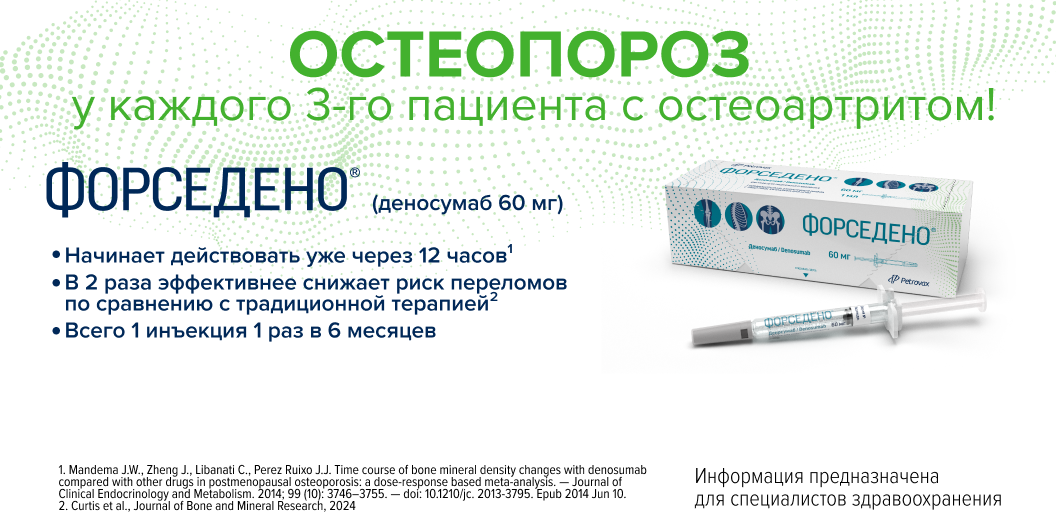
Dietary supplements are included in updated osteoarthritis Clinical guidelines for the first time
The Ministry of Health of the Russian Federation has published revised clinical guidelines for the management of patients with generalized osteoarthritis[1] — one of the most common joint disorders. The document reflects new approaches to comprehensive therapy and, for the first time, includes nutritional support and evidence-based dietary supplements (DS) as an adjunct therapeutic option.
Osteoarthritis is among the most prevalent musculoskeletal disorders. The disease affects all joint structures. According to official statistics, more than 4.3 million patients with osteoarthritis are registered in Russia[2]. However, epidemiological studies suggest that the actual number may reach 15 million[3]. Nearly 40% of these patients are of working age[2].
The condition develops due to a combination of age-related, hormonal, genetic, and external factors, including obesity, injuries, and occupational load[1]. Osteoarthritis prevalence increases with age and is more common in women[1].
Osteoarthritis treatment currently relies on a comprehensive approach that includes non-pharmacological methods (weight reduction, physical therapy, orthopedic support), medical treatment (chondroprotectors, NSAIDs, intra-articular steroids), and surgical treatment.
For the first time, the updated document includes a recommendation to prescribe dietary supplements with an evidence base, as they can reduce pain and improve functional activity in patients with osteoarthritis. Active ingredients listed in the clinical guidelines include oral collagens, methylsulfonylmethane (MSM), vitamin D, boswellic acids, and a number of other components.
These agents help protect joint tissues from degeneration, support tissue renewal, reduce pain and swelling, and maintain joint function.
Native type II collagen helps the immune system avoid perceiving the body’s own collagen — released when cartilage is damaged — as a foreign protein. As a result, the immune response decreases and cartilage degradation slows.
According to clinical study data[5], a combination of undenatured type II collagen with boswellic acids, MSM, and vitamins D3 and C provides a statistically significant reduction in the total WOMAC index and promotes a faster improvement in quality of life compared with the traditional combination of chondroitin sulfate and glucosamine hydrochloride.
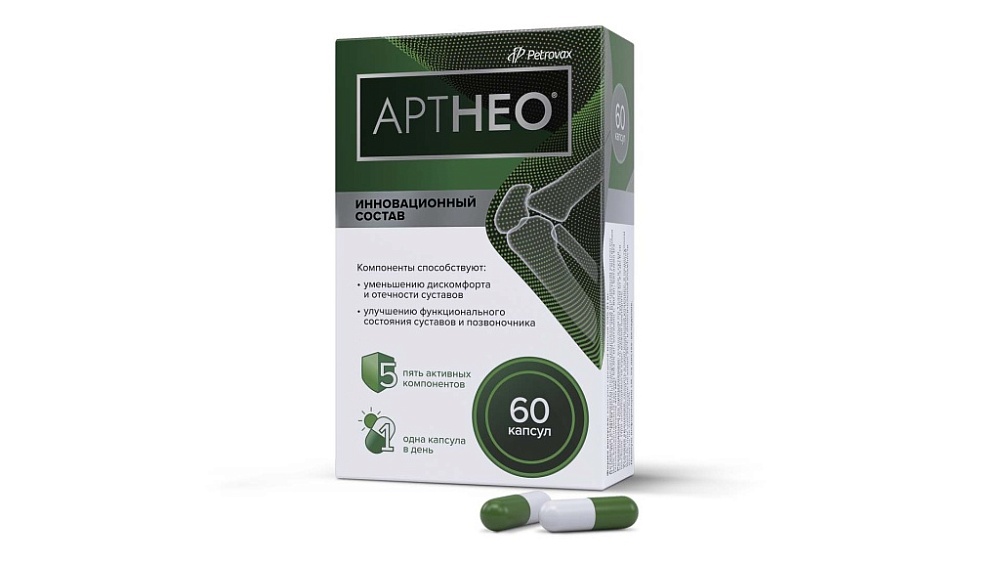
The inclusion of nutritional support, including collagen-based complexes (such as Artneo®), in clinical guidelines reflects the growing role of evidence-based nutraceuticals in the comprehensive management of osteoarthritis and offers additional opportunities to improve treatment effectiveness and patient quality of life.
Background Information
Artneo® is a dietary supplement containing a unique native type II collagen with a fundamentally new mechanism of action for supporting joint and spine health, along with Boswellia extract, MSM (methylsulfonylmethane), vitamin C, and vitamin D3. Artneo® provides a comprehensive effect by helping to reduce discomfort, swelling, pain, and stiffness, while supporting recovery and maintenance of joint and spine function. A number of clinical studies confirm the positive impact of native type II collagen in reducing osteoarthritis symptoms[5], [6]. In osteoarthritis, the immune system may recognize the body’s own type II collagen released during joint destruction as foreign, triggering an inflammatory response. Undenatured type II collagen helps «train» the body not to respond with inflammation to its own collagen: it promotes the production of anti-inflammatory cytokines and reduces inflammation.
1 https://cr.minzdrav.gov.ru/view-cr/256_2 (in Russian)
2 Balabanova R.M., Dubinina T.V. Five-year trends in the incidence of musculoskeletal diseases and their prevalence among the adult population of Russia in 2013–2017. Modern Rheumatology Journal. 2019;13(4):11–17 (in Russian).
3 Galushko E.A., Bolshakova T.Yu., Vinogradova I.B. et al. Structure of rheumatic diseases among the adult population of Russia according to an epidemiological study (preliminary results). Rheumatology Science and Practice. 2009;47(1):11–17 (in Russian).
4 https://petrovax.com/press_centre/news/2025/novyj-ehtap-v-lechenii-osteoporoza-i-osteoartrita-sovremennye-terapevticheskie-podhody/
5 Mazurov Vadim Ivanovich, Belyaeva Irina Borisovna, Trofimov Evgeny Aleksandrovich, Itskovich Irina Emmanuilovna, Burulev Artem Leonidovich. Comparison of the efficacy of a combination of undenatured type II collagen, boswellic acids, methylsulfonylmethane, vitamins C and D3 versus a combination of chondroitin sulfate and glucosamine hydrochloride in the treatment of primary knee osteoarthritis. Terapevticheskii Arkhiv. 2023;(12) (in Russian).
6 Lila A.M., Alekseeva L.I., Belyaeva I.B., Vinogradova I.B., Demidova N.A., Kalyuzhin O.V., Nesterovich I.I., Sorotskaya V.N., Shirokova L.Yu., Yakupova S.P. Expert Council Resolution: Results of a multicenter randomized double-blind placebo-controlled study of Artneo in patients with primary knee osteoarthritis, stage II–III. Modern Rheumatology Journal. 2023;17(6):136–142. https://doi.org/10.14412/1996-7012-2023-6-136-142 (in Russian)
Only 9% of adults vaccinated against pneumococcus: physicians call for stronger pneumonia prevention