A Russian compound becomes the first in the world to demonstrate a significant improvement of exercise tolerance among patients with post-COVID lung injury in a multicenter randomized controlled trial
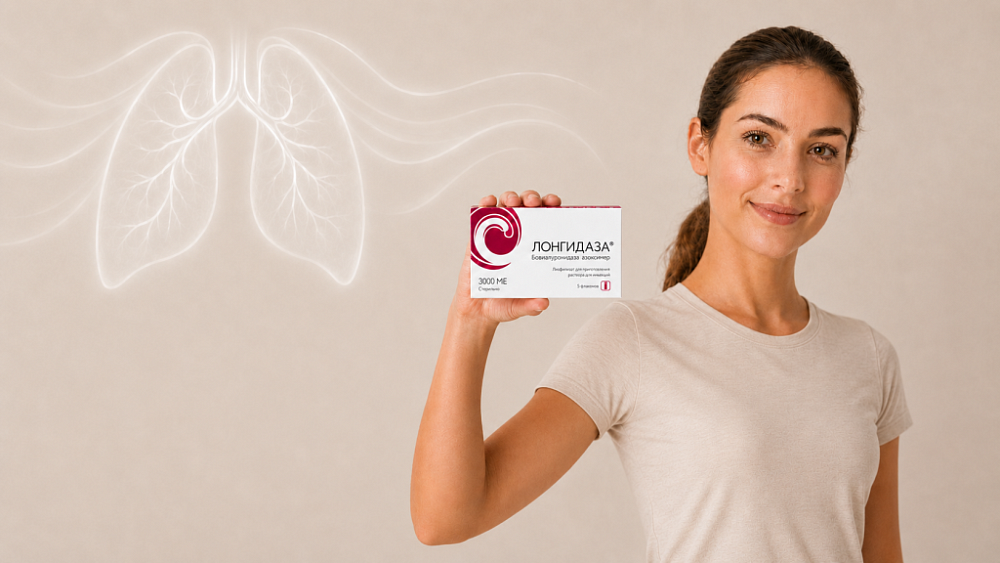
Petrovax Pharm has announced the results of a randomized, double-blind, placebo-controlled study of HA-targeted therapy for post-COVID lung injury. The study demonstrated a statistically significant reduction in exercise-induced oxygen desaturation and dyspnea following treatment with bovhyaluronidase azoximer (Longidaza®). The results were published in June 2026 in the international journal Expert Review of Respiratory Medicine[1].
According to the World Health Organization, post-COVID syndrome develops in 10–20% of individuals who have had COVID-19[2], affecting at least 65 million people worldwide[3]. The most frequently observed clinical features include impaired lung function, manifesting in dyspnea, chronic cough, and decreased exercise tolerance[4]. Despite the significant burden, there are currently no approved pharmacological treatments for long-term post-COVID pulmonary complications.
The Long-CoV-III-21 study enrolled 392 patients with post-COVID lung abnormalities, impaired respiratory function, and persistent respiratory symptoms. The study subjects received either bovhyaluronidase azoximer or placebo for 71 days and were then followed up to Day 180.
Bovhyaluronidase azoximer is a long-acting hyaluronidase-based medicinal product. Its molecular target is hyaluronic acid (HA), which accumulates excessively in the lungs during COVID-19, causing edema and inflammation that eventually result in fibrosis.
By Day 71, the proportion of patients experiencing exercise-induced oxygen desaturation had decreased by 61% compared with placebo (p = 0.006). By Day 180, the proportion of patients with exertional dyspnea had decreased by 35% (p = 0.008). In addition, the treatment demonstrated a trend toward improvement in the 6-minute walk test (6MWT) distance, with patients in the bovhyaluronidase azoximer group increasing their walking distance by 70.3 meters, compared with 59.3 meters in the placebo group (p = 0.072). Improvement in dyspnea at rest was observed in 82% of patients receiving bovhyaluronidase azoximer versus 74% of patients receiving placebo (p = 0.053).
These findings become particularly important in the broader context of post-COVID research area. In placebo-controlled studies of other therapies for post-COVID conditions, significant improvements in exercise tolerance have not been demonstrated. In a study of colchicine (N = 346), no difference in 6MWT distance was observed between treatment groups[5]. The antifibrotic agent pirfenidone failed to show benefits in either walking distance or oxygen saturation in the FIBRO-COVID study (N = 113)[6]. Similarly, in a study of the metabolic modulator AXA1125, improvements in walking distance were nearly identical in both groups[7]. Longidaza® is the first medicinal product to demonstrate improved exercise tolerance in patients with post-COVID pulmonary abnormalities in a large-scale, double-blind, placebo-controlled randomized clinical trial.
According to the study authors, these findings open new avenues for investigating the role of hyaluronic acid and the potential of HA-targeted therapies in post-viral conditions associated with pulmonary inflammation and fibrosis.
Background Information
Longidaza® (bovhyaluronidase azoximer) is an enzymatic medicinal product with prolonged anti-inflammatory and antifibrotic activity and more than 20 years of clinical use. Owing to its polymer carrier, hyaluronidase activity remains detectable in circulation for up to 20 days, compared with approximately 1 day for native bovhyaluronidase[8]. The product is administered for the treatment and prevention of diseases associated with inflammation and connective tissue hyperplasia (fibrosis and adhesions)[9]. It is utilized in urology, gynecology, pulmonology, surgery, dermatology, aesthetic medicine, and rheumatology.
1 Avdeev S.N. et al. Bovhyaluronidase azoximer for long-term pulmonary sequelae of COVID-19: a multicenter, randomized, double-blind, placebo-controlled study. Expert Review of Respiratory Medicine. 9 июня 2026. DOI 10.1080/17476348.2026.2684077; PMID 42261259. Open Access (CC BY-NC-ND). Исследование Long-CoV-III-21; NCT06383819 2 WHO. Coronavirus disease (COVID-19): post COVID-19 condition. 2023. https://www.who.int/news-room/questions-and-answers/item/coronavirus-disease-(covid-19)-post-covid-19-condition 3 Davis HE, McCorkell L, Vogel JM, et al. Long COVID: major findings, mechanisms and recommendations. Nature Reviews Microbiology. 2023;21(3):133-146. doi:10.1038/s41579-022-00846-2 4 Singh SJ, et al. Respiratory sequelae of COVID-19: pulmonary and extrapulmonary origins, and approaches to clinical care and rehabilitation. The Lancet Respiratory Medicine. 2023;11(8):709-725. doi:10.1016/S2213-2600(23)00159-5 5 Colchicine for post-COVID-19 condition: a randomized, double-blind, placebo-controlled trial. JAMA Internal Medicine. 2025. PMID: 41114999. https://pubmed.ncbi.nlm.nih.gov/41114999/ 6 Pirfenidone in post-COVID-19 pulmonary fibrosis (FIBRO-COVID): a phase 2 randomised clinical trial. European Respiratory Journal. 2025;65(4):2402249. PMID: 40154560. https://pubmed.ncbi.nlm.nih.gov/40154560/ 7 Finnigan LEM, et al. Efficacy and tolerability of AXA1125 in fatigue-predominant long COVID: a randomised, double-blind, placebo-controlled phase 2a pilot study. eClinicalMedicine. 2023. PMID: 37223439. https://pubmed.ncbi.nlm.nih.gov/37223439/ 8 Longidaza® Prescribing Information and Dosing Regimens®. https://www.longidaza.ru/instruction/ 9 Kulchavenya E.V., Shevchenko S.Yu., Cherednichenko A.G., Breusov A.A., Vinitsky A.A. New Opportunities for the Use of Hyaluronidase in Chronic Prostatitis. Urologiya. 2020;(3). https://dx.doi.org/10.18565/urology.2020.3.56-62
Petrovax Pharm joins industry discussion on expanding access to innovative therapy at Forum in Uzbekistan