Osteoporosis and osteoarthritis in patients with comorbidities: a comprehensive approach and novel therapeutic options

Osteoporosis and osteoarthritis are highly prevalent chronic diseases that significantly impair the quality of life of older adults. They are frequently accompanied by cardiovascular, endocrine, and other comorbid conditions. The challenge of safe treatment in patients with multiple coexisting diseases was the central topic of the multidisciplinary summit "Comorbidity as a Challenge: From a Mosaic of Clinical Guidelines to Personalized Pharmacotherapy," held as part of the Man and Medicine Forum.
Osteoporosis is a prevalent disease affecting more than 14 million people in Russia[1]. According to expert estimates, the number of patients will increase to 16 million by 2035[1].
Each osteoporotic fracture increases the risk of subsequent fractures and significantly raises the likelihood of disability and premature death. Timely diagnosis and treatment can improve patients’ quality of life. However, treatment selection is often complicated by the presence of comorbidities.
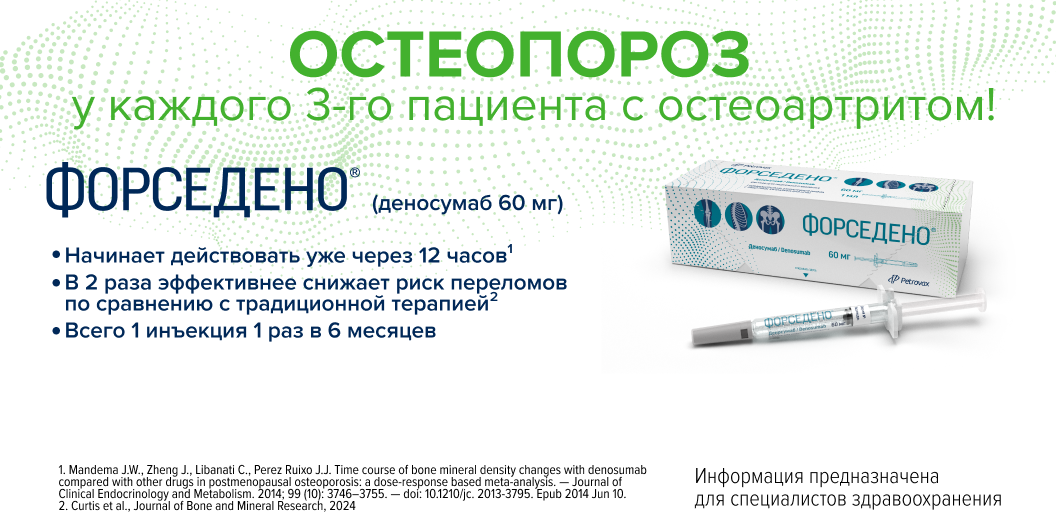
The cornerstone of osteoporosis treatment consists of bisphosphonates and denosumab, a monoclonal antibody therapy. Forsedeno®, a biosimilar of the reference denosumab product, was approved in Russia in 2025. Unlike bisphosphonates, denosumab provides a safe anti-osteoporotic treatment option for patients with comorbid conditions and does not require dose adjustment in patients with impaired renal function.
Today, more than 19,000 Russian patients receive Forsedeno®. Its approval has significantly expanded treatment options, including for patients with multiple comorbidities. Denosumab is the only antiresorptive agent that can be used in patients with chronic kidney disease and those undergoing hemodialysis. In addition, it has been shown to reduce the risk of developing type 2 diabetes mellitus by approximately one-third and to exert favorable effects on the cardiovascular system[2], [3].
Another condition commonly seen in older adults is osteoarthritis, which affects 13–42% of patients and is a leading cause of disability among the elderly[4].
A comprehensive approach is recommended for the management of osteoarthritis, combining pharmacological interventions with non-pharmacological measures such as physical activity, weight reduction, and the use of dietary supplements. The latter were included for the first time in the updated clinical guidelines for polyarthrosis (generalized osteoarthritis)[5]. According to the document, dietary supplements with an evidence base may be used if they contain collagen, boswellic acids, methylsulfonylmethane (MSM), vitamin D, and other substances.
Clinical studies have evaluated the combination of undenatured type II collagen, boswellic acids, MSM, and vitamins C and D, a combination also included in ArtNEO®. The data indicate a potential reduction in pain and signs of inflammation as early as 7 days after starting use, with no adverse effects typical of NSAIDs[6].
Experts concurred that the presence of osteoporosis or osteoarthritis requires a comprehensive approach. When more than half of patients with osteoporosis have concomitant ischemic heart disease, and every fourth patient with osteoarthritis has five to six additional conditions, treatment selection requires dual responsibility: treatment must improve the patient’s quality of life without compromising overall health.
1 Lesnyak O.M. Audit of the state of osteoporosis in Eastern Europe and Central Asia. 2010. 2 Hsu TW, Hsu CN, Wang SW, Huang CC, Li LC. Comparison of the Effects of Denosumab and Alendronate on Cardiovascular and Renal Outcomes in Osteoporotic Patients. J Clin Med. 2019;8(7):932. Published 2019 Jun 28. doi:10.3390/jcm8070932 3 Lyu H, Zhao SS, Zhang L, Wei J, Li X, Li H, Liu Y, Yin P, Norvang V, Yoshida K, Tedeschi SK, Zeng C, Lei G, Tang P, Solomon DH. Denosumab and incidence of type 2 diabetes among adults with osteoporosis: population based cohort study. BMJ. 2023 Apr 18;381:e073435. doi: 10.1136/bmj-2022-073435. PMID: 37072150; PMCID: PMC10111187. 4 Ivkin D.Yu., Ivkina A.S. Symptomatic slow-acting drugs in the treatment of osteoarthritis. Lechaschi Vrach. 2012;(7):100–104. 5 Polyarthrosis (generalized osteoarthritis). Clinical guidelines. https://cr.minzdrav.gov.ru/view-cr/256_2 6 Mazurov V.I., Belyaeva I.B., Trofimov E.A., Itskovich I.E., Burulev A.L. Comparison of the efficacy of a combination of undenatured type II collagen, boswellic acids, methylsulfonylmethane, vitamins C and D3 versus a combination of chondroitin sulfate and glucosamine hydrochloride in the treatment of primary knee osteoarthritis. Therapeutic Archive. 2023;12(2):1141–1150.
Pneumococcal infection in adults: high risk of complications calls for expanded vaccination coverage