Russia’s Ministry of Health approves the country’s first domestically produced quadrivalent meningococcal vaccine
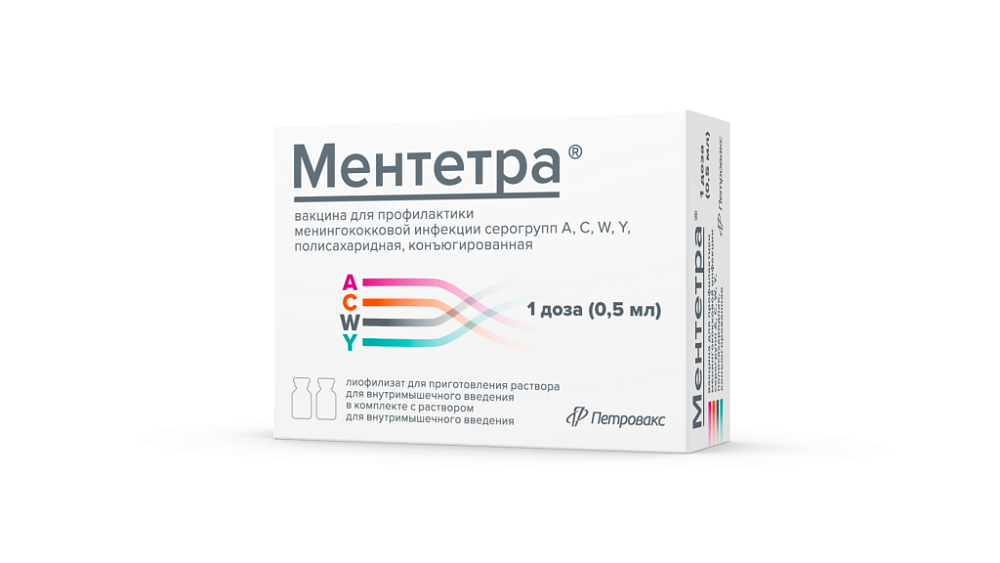
Biopharmaceutical company Petrovax Pharm has received marketing authorization for Mentetra®, a quadrivalent conjugate vaccine for the prevention of meningococcal infection. Investment in establishing full-cycle production of the vaccine has exceeded RUB 3 billion. The approval creates new opportunities to expand Russia’s National Immunization Schedule and protect children’s lives and health from an infection with one of the highest case fatality rates, reaching 20% [1], [6].
Mentetra® is indicated for the prevention of meningococcal infection caused by serogroups A, C, W, and Y in children from three months of age and adults up to 55 years of age. According to the prescribing information, the recommended vaccination schedule comprises three doses for infants aged 3–5 months, two doses for children aged 6–23 months, and a single dose (0.5 mL) for children aged two years and older and adults aged 18–55 years.
Petrovax Pharm has been implementing a project to localize meningococcal vaccine production since 2022. In January 2026, Russia’s Ministry of Industry and Trade expanded the company’s manufacturing license to include the meningococcal vaccine. By early 2027, the company’s production capacity will exceed 6 million doses per year. According to Mikhail Tsyferov, President of Petrovax Pharm, this capacity will fully meet the needs of Russia’s healthcare system once meningococcal vaccination is included in the National Immunization Schedule.
“The approval of Mentetra marks the completion of a key stage in a major project to develop vaccine manufacturing in Russia. We have localized the full production cycle and are ready to supply the volumes required by the Russian market. We expect domestic production to help create the conditions for including meningococcal vaccination in the National Immunization Schedule. The project also has export potential, primarily in the Eurasian Economic Union and other markets where the need for meningococcal infection prevention remains high,”
Meningococcal infection ranks first among infectious causes of death in children [2]. Potential consequences include central nervous system damage, cognitive impairment, hearing and vision loss, musculoskeletal damage, and amputations. Up to 70% of patients who survive the infection require long-term rehabilitation [3].
The need for routine prevention is becoming increasingly urgent as incidence rises in Russia. In 2025, the incidence of invasive meningococcal infection was 2.7 times higher in the previous year [4].
“Meningococcal infection remains one of the most dangerous vaccine-preventable diseases: it can progress rapidly and claim a child’s life within just 24 hours, while more than 28% of survivors experience severe, disabling complications. Meanwhile, incidence continues to rise, making prevention particularly urgent. The approval of a Russian quadrivalent vaccine is an important step in protecting children and adults: we now have a domestically produced vaccine that enables a transition from vaccination based on epidemiological indications to routine immunization,”
In 2025, the vaccine underwent Phase III clinical trial at 16 medical clinical centers in Russia. The results demonstrated that the vaccine was non-inferior to the comparator vaccine in terms of immunogenicity against all four serogroups (A, C, W, and Y) and induced significantly higher antibody titers against serogroup C [5]. Specifically, following a single dose, the geometric mean titer of serum bactericidal antibodies against serogroup C was 37% higher than in the comparator vaccine group [5]. Seroconversion rates for all four serogroups A, C, W, and Y, which account for the majority of severe cases, ranged from 98% to 100% [5]. The vaccine based on this technology has been widely used around the world since 2021, and more than 5 million children have been vaccinated with it.
Before Mentetra was approved, meningococcal vaccination in Russia was primarily recommended based on epidemiological indications and for selected risk groups. Experts cited the lack of domestic full-cycle production of modern quadrivalent vaccines as one of the factors limiting the transition to routine immunization. The approval of a vaccine manufactured through a full production cycle enables a reliable supply of the vaccine in the volumes required for inclusion of meningococcal vaccination in the National Immunization Schedule.
References
1 Epidemiology and Vaccine Prevention. (In Russian)
2 Koroleva M.A., Gritsay M.I., Koroleva I.S., Akimkin V.G., Melnikova A.A. Purulent bacterial meningitis in the Russian Federation: epidemiology and vaccine prevention. Zdorovye Naseleniya i Sreda Obitaniya. 2022;30(12):73–80. (In Russian)
3 Mazankova L.N., Tebenkov A.V., Rossina A.L. Meningococcal infection in children: new challenges. Praktika Pediatra. 2021;(3):25–29. (In Russian)
4 State Report “On the State of Sanitary and Epidemiological Well-Being of the Population of the Russian Federation in 2025.” Rospotrebnadzor. (In Russian)
5 Namazova-Baranova Leyla S., Fedoseenko Marina V., Efendieva Kamilla E., Kalyuzhnaya Tatyana A., Tolstova Svetlana V., Sel’vyan Arevaluis M., Kostinov Mikhail P., Fel’dblyum Irina V., Vilnits Alla A., Kharit Susanna M., Romanenko Viktor V., Popova Varvara V., Chudinovskikh Tatyana I., Pak Tatyana E., Gamova Inna V., Aleshina Lyubov V., Trusova Olga V., Perminova Olga A., Semerikov Vladislav V., Lazareva Svetlana G., Garina Svetlana V., Omarova Khadizhat G., Rtishchev Aleksey Yu., Kozlova Elena Yu., Gorelov Aleksandr V. Immunogenicity, Reactogenicity, and Safety of CRM197-Conjugated Meningococcal A, C, W, Y Vaccine: Multicenter, Randomized, Phase III Trial. Voprosy sovremennoi pediatrii — Current Pediatrics. https://vsp.spr-journal.ru/jour/article/view/4097 (In Russian)
6 Meningococcal infection in the Russian Federation: a ten-year observation. (In Russian)
The risks of putting it off: experts discussed the link between prostatitis and men’s sexual and reproductive health