Denosumab Included in Russian Ministry of Health Clinical Guidelines for the Treatment of Osteonecrosis
The Russian Ministry of Health has included denosumab in its clinical guidelines for the treatment of aseptic bone necrosis (osteonecrosis)[1]. The medicine is recommended as part of comprehensive treatment, including for patients in whom the use of bisphosphonates is limited. Previously, prescribing antiresorptive therapy for osteonecrosis required a decision by a medical commission. Its inclusion in the updated clinical guidelines expands treatment options for the disease.
Aseptic necrosis is a condition in which impaired blood supply to bone tissue leads to its damage and destruction. Osteonecrosis often affects people of working age and can reduce their quality of life[1]. Estimates based on international epidemiological data suggest that between 5,000 and 8,000 new cases may be diagnosed in Russia each year[1]. Osteonecrosis of the femoral head is more common in men aged 33–45, while necrosis of the femoral and tibial condyles occurs predominantly in women over 55[1].
One of the main symptoms is joint pain that worsens with movement and weight-bearing. It can occur suddenly, even without an obvious injury. Pain severity does not always correspond to the changes seen on X-rays, making timely diagnosis difficult. As the disease progresses, it can lead to destruction of the articular surfaces, reduced mobility and the need for joint replacement surgery[1].
Comprehensive treatment for osteonecrosis includes nonsteroidal anti-inflammatory drugs, reduced loading of the affected joint, calcium and vitamin D supplements, and other agents that affect bone structure and mineralization. The updated clinical guidelines recommend the use of antiresorptive therapy to reduce bone destruction, including denosumab and bisphosphonates.
“Including denosumab in the clinical guidelines will expand the range of antiresorptive agents available as part of comprehensive treatment for patients with osteonecrosis,”
Denosumab is a fully human monoclonal antibody that blocks the activity of RANKL, a protein that plays a key role in the formation and function of osteoclasts, the cells involved in breaking down bone tissue. By inhibiting osteoclast activity, the medicine reduces bone resorption. According to the clinical guidelines, denosumab has also demonstrated efficacy and safety in treating bone marrow edema, the first stage of osteonecrosis.
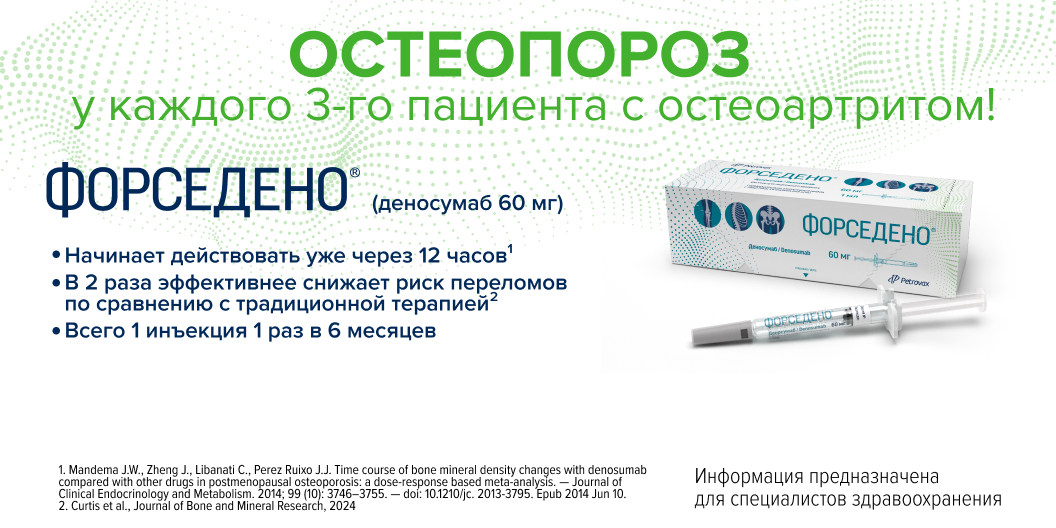
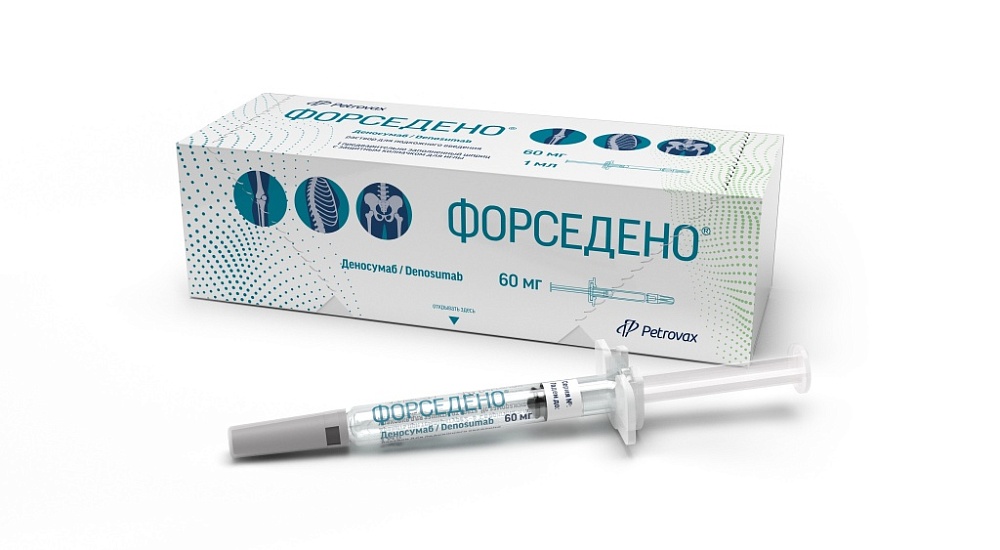
Forsedeno®, a Russian biosimilar of denosumab, has been used in Russia since 2025. Its marketing authorization has expanded access to modern therapy in the country, particularly for patients with osteoporosis. Today, more than 25,000 people in Russia receive Forsedeno®.
The inclusion of denosumab in the Russian Ministry of Health’s clinical guidelines for osteonecrosis reflects advances in approaches to pharmacological treatment of the disease. The ability to prescribe the medicine without a decision by a medical commission simplifies clinical decision-making and expands opportunities to use modern treatments in Russia.
Background Information
Forsedeno® (denosumab) is a protein—a fully human monoclonal antibody—that inhibits the activity of RANKL (receptor activator of nuclear factor kappa-B ligand), a key molecule in osteoclast formation. During bone metabolism, osteoclasts remove bone tissue by dissolving its mineral component[2]. By blocking this protein, denosumab inhibits osteoclast formation, function and survival, thereby reducing bone resorption (the breakdown and removal of bone tissue). This leads to a rapid increase in bone mass throughout the skeleton and reduces the risk of vertebral and nonvertebral fractures.
Forsedeno® is supplied in prefilled syringes and is used to treat:
- osteoporosis in women after menopause (postmenopausal osteoporosis) and osteoporosis in men at increased risk of bone fractures;
- bone loss due to reduced testosterone levels resulting from surgery or the use of medicines in men with prostate cancer;
- bone loss associated with long-term systemic glucocorticoid therapy in adult patients at increased risk of fractures.
References
1 Russian Ministry of Health. Clinical guidelines. Aseptic Necrosis of Bone (Osteonecrosis). https://cr.minzdrav.gov.ru/preview-cr/1065_1 (In Russian)
2 Sözen T, et al. An overview and management of osteoporosis. European Journal of Rheumatology. 2017;4(1):46–56. doi:10.5152/eurjrheum.2016.048.