OsteoForce, a large-scale study, launches in Russia: a new step in osteoporosis management

A large prospective observational study, OsteoForce, has been launched in Russia to assess the real-world effectiveness and safety of osteoporosis treatment in routine clinical practice. The study will enroll 192 patients over 50 years of age from more than 20 federal and regional osteoporosis treatment centers. Professor Olga M. Lesnyak, doctor of medical science, President of the Russian Osteoporosis Association, will serve as the principal medical expert and national coordinator of the study.
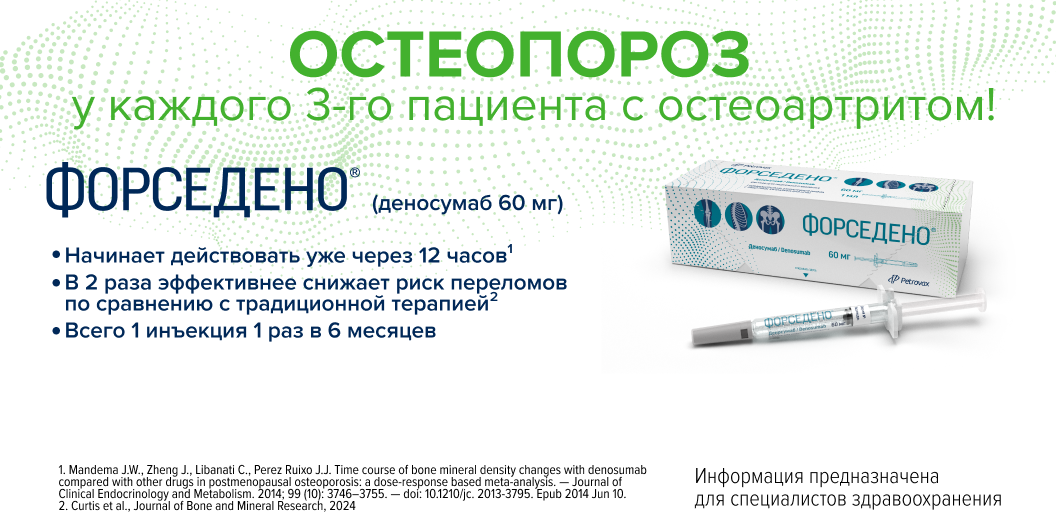
The open-label prospective observational OsteoForce study will include patients over 50 years of age with a diagnosis of "osteoporosis in men at high risk of fractures" or "postmenopausal osteoporosis". The project is designed to perform a comparative assessment of the effectiveness and safety of antiresorptive therapy with Forsedeno®, the first and only denosumab biosimilar, versus the reference product in patients with osteoporosis in the Russian Federation. The study will be conducted at leading federal and regional osteoporosis centers across Russia, including Moscow, Saint Petersburg, Yekaterinburg, Kazan, Novosibirsk, Volgograd, Voronezh, Krasnoyarsk, and Ulyanovsk.

Study participants will receive therapy with Forsedeno® for 1–2 years. During this period, changes in bone mineral density, clinical symptoms of the disease, quality of life, and muscle strength will be assessed. The analysis of historical medical data will further strengthen the evidence base for the biosimilar, taking into account the characteristics of Russian patients, and will provide valuable insights into real-world clinical practice in osteoporosis management across different regions of the country.
The OsteoForce project is part of a broader social initiative by Petrovax Pharm, which includes the "Affordable Osteoporosis Therapy with Forsedeno®" program, aimed at improving access to modern treatments for chronic diseases.
Osteoporosis is one of the most prevalent chronic disorders of the musculoskeletal system. According to official data alone, 16 million people in Russia are affected. The disease is associated with fractures that pose a serious risk to life and health and may occur even under minimal loading—for example, after a fall from standing height, with coughing, or when lifting a heavy object[1]. The most dangerous are femoral fractures; vertebral compression fractures are also very common and lead to back pain, loss of height, and spinal deformity[1]. Osteoporosis most often develops after the age of 50, but in the presence of certain risk factors it can also occur at a younger age[1].
Background information
OsteoForce
OsteoForce is an open-label prospective observational study with a historical control and retrospective assessments. It is designed to provide a comparative evaluation of the effectiveness and safety of antiresorptive therapy with Forsedeno®, the first denosumab biosimilar, versus the reference product in Russian patients with osteoporosis.
The primary endpoint of the study is the absence of statistically significant differences in the percentage change in bone mineral density (BMD) of the lumbar spine at 12 months (per-protocol [PP] population) between the groups "Forsedeno vs. Retro-Conversion" and "Retro-Conversion vs. Prospect-Conversion".
Secondary endpoints include: assessment of statistically significant differences in the percentage change in total hip BMD at 12 months (PP population) between the groups "Forsedeno vs. Retro-Conversion" and "Retro-Conversion vs. Prospect-Conversion"; absence of statistically significant differences in the percentage change in lumbar spine BMD at 24 months; absence of statistically significant differences in the percentage change in total hip BMD at 24 months between the groups "Forsedeno vs. Retro-Conversion + Prospect-Conversion" and "Forsedeno vs. Retro-Conversion + Prospect-Conversion"; analysis of differences in pain intensity assessed by the visual analogue scale (VAS), quality of life assessed by the EQ-5D questionnaire, and handgrip strength in the "Prospect-Conversion" group (baseline vs. end of study at 12 months) and in the "Forsedeno" group (baseline vs. end of study at 24 months).
Key inclusion criteria are: diagnoses of "osteoporosis in men at high risk of fractures" or "postmenopausal osteoporosis"; a T-score for total hip of −2.5 SD or less prior to initiation of denosumab therapy; age 50 years or older; and initiation of denosumab therapy before enrollment in the study.
Forsedeno® (denosumab) is a protein and a fully human monoclonal antibody that inhibits the activity of RANKL (receptor activator of nuclear factor kappa-B ligand), a key molecule in the formation of osteoclasts. Osteoclasts are cells that remove bone tissue by dissolving its mineral matrix during bone metabolism. By blocking RANKL activity, denosumab suppresses the formation, function, and survival of osteoclasts and thereby reduces the rate of bone resorption (degradation, breakdown). This leads to a rapid increase in bone mass throughout the skeleton and a reduction in the risk of vertebral and non-vertebral fractures.
Forsedeno® is supplied in pre-filled syringes and is indicated for the treatment of:
• osteoporosis in postmenopausal women (postmenopausal osteoporosis) and osteoporosis in men at increased risk of bone fractures;
• bone loss due to reduced testosterone levels resulting from surgery or medicinal products in men with prostate cancer;
• bone loss associated with long-term systemic glucocorticoid therapy in adult patients at increased risk of fractures.
1 Clinical guidelines of the Russian Ministry of Health "Osteoporosis" https://cr.minzdrav.gov.ru/preview-cr/87_4