A hidden epidemic: Russia revises its approach to combating iron deficiency

Russia has approved new Guidelines for the Management of Patients with Iron Deficiency Anemia (IDA) for primary care physicians[1]. The document updates current approaches to early diagnosis and prevention of iron deficiency, expands the list of at-risk groups, and establishes modern standards for nutritional support. The need for a systematic review of existing practices was previously highlighted in the resolution of the Advisory Board on IDA*, published in the journal Primary Health Care[2].
Both documents emphasize the importance of using safe and well-tolerated methods of IDA correction, particularly chelated iron forms, such as ferrous bisglycinate, known for its high bioavailability and good tolerability.
The guidelines reflect the growing attention of the medical community to iron deficiency disorders. According to experts, every third person (33%) in the world suffers from anemia, with the primary cause being iron deficiency[1]. In Russia, 1.5 million people have been diagnosed with anemia[1], though the true numbers are likely much higher due to underdiagnosis of latent forms.
According to the updated Guidelines, iron deficiency prevention is required for women of reproductive age, patients at risk of abnormal uterine bleeding, pregnant and breastfeeding women, elderly people (especially those with comorbidities), athletes, vegetarians and vegans, and regular blood donors. The Advisory Board also recommended including the same categories in the Clinical Guidelines for IDA.
To replenish iron stores and prevent anemia, the Guidelines recommend 30–60 mg of elemental iron per day, in line with the WHO population strategy. High-dose iron supplements can cause gastrointestinal side effects, reducing adherence. For this reason, special attention is given to new chelated forms of iron, particularly ferrous bisglycinate, which offers higher bioavailability (up to 90%) and better tolerability compared to traditional iron salts.
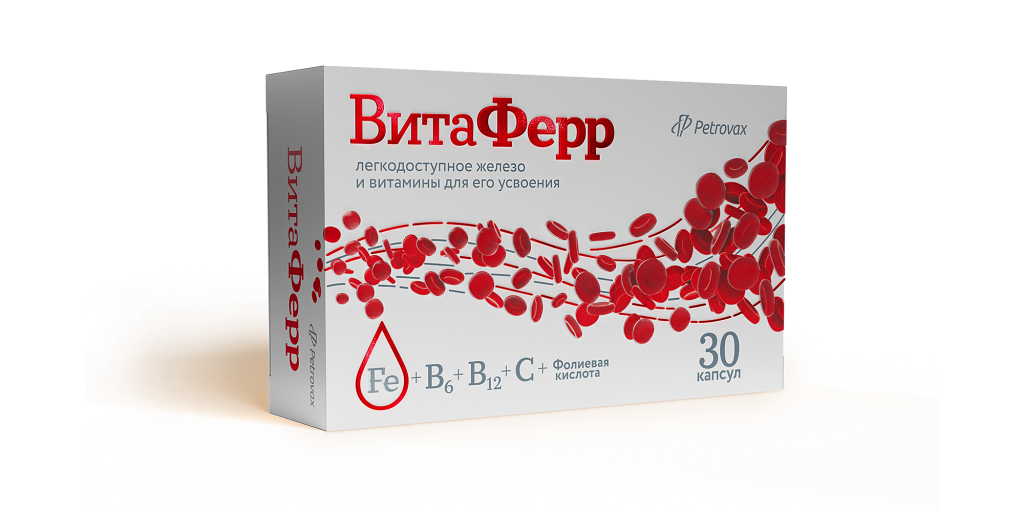
According to the new Guidelines, a daily dose of 30 mg of iron is considered optimal for preventing iron deficiency in at-risk populations. This amount can also be provided through dietary supplements containing iron in combination with vitamin C, folic acid, and B-group vitamins, all of which play a key role in hematopoiesis.
Such dietary supplements facilitate management of iron deficiency as effectively as traditional ferrous sulfate, while using lower doses and offering significantly better tolerability. For example, a clinical trial in patients with mild anemia demonstrated that a combination of 30 mg of ferrous bisglycinate, L-methylfolate, vitamin C, and vitamins B₆ and B₁₂ (Vitaferr® dietary supplement) is as effective as 200 mg of iron sulfate, but causes adverse effects 2.3 times less frequently[5].
The new Guidelines include an updated algorithm for the identification and management of patients with latent iron deficiency (LID) and iron deficiency anemia (IDA).
The close attention of the medical community to LID and IDA reflects the urgency of the problem and the need for immediate measures to reduce the burden of iron deficiency. The Advisory Board additionally called for strengthening educational programs for primary care physicians and improving public awareness of the signs and risks of iron deficiency.
* The published resolution of the Advisory board was the result of the first large-scale, comprehensive discussion of the serious issues of identifying, preventing, and treating LID and IDA, involving Russian key opinion leaders in internal medicine, geriatrics, hematology, gastroenterology, obstetrics and gynecology, nutrition, preventive medicine, and clinical pharmacology.
Background information
Every year on 26 November, the world marks Iron Deficiency Day. According to the Federal State Statistics Service, anemia remains highly prevalent in Russia: in 2022, the condition was registered in 1.5 million people, and anemia was diagnosed for the first time in 485,000 individuals[6]. In the Russian Federation, collecting reliable statistical data on the overall incidence of anemia, IDA, and latent iron deficiency (LID) remains challenging[1]. Estimates suggest that IDA accounts for ~75% of all anemia cases[7]. Among Russian federal districts, the highest anemia prevalence per 100,000 population in 2020 was recorded in the Volga (1,207.3), Siberian (1,089.1), and Ural (1,057.4) federal districts[8].
Iron is one of the key trace elements required for normal body function[9]. It is involved in regulation of the cell cycle; synthesis, replication, and repair of DNA; mitochondrial respiratory chain function; erythropoiesis; muscle energy metabolism; development and activity of immune cells; and collagen and thyroid hormone synthesis. Iron is also essential for growth and proper functioning of brain cells.
Iron deficiency disrupts multiple physiological processes: it impairs metabolism, causes cognitive decline and sexual health deterioration, reduces physical endurance and work capacity, and negatively affects overall quality of life.
The largest cohort affected by anemia consists of women of reproductive age and pregnant women, in whom the condition is observed in 36% of cases[10]. The problem is also common among older adults[11], patients with chronic diseases, including gastrointestinal disorders[13], vegetarians, regular blood donors, and socially vulnerable populations[12].
The high prevalence of IDA in Russia is driven by a number of factors[13], including insufficient dietary iron intake, poor public awareness of the symptoms and risks of iron deficiency, and socioeconomic barriers limiting access to a balanced diet. Women of reproductive age remain particularly vulnerable: unbalanced diets, restrictive eating patterns, and low adherence to treatment further increase their risk. Another important factor is the lack of comprehensive preconception care, including routine screening for iron deficiency and its timely correction before pregnancy[13].
1 Drapkina O.M., Avalueva E.B., Bakulin I.G. et al. Management of patients with iron deficiency anemia at the stage of primary health care: updated methodological guidelines. Primary Health Care. 2025;2(3):55–114. (In Russ.). https://doi.org/10.15829/3034-4123-2025-61
2 Drapkina O.M., Tkacheva O.N. et al. Prevention of iron deficiency and iron deficiency anemia in various patient groups in the Russian Federation. Resolution of the Advisory Board. Primary Health Care. 2025;2(3):21–34. (In Russ.). doi:10.15829/3034-4123-2025-74
3O. Pineda, H D Ashmead Effectiveness of treatment of iron-deficiency anemia in infants and young children with ferrous bis-glycinate chelate. Nutrition. 2001 May;17(5):381-4. doi: 10.1016/s0899-9007(01)00519-6
4Ahmed M Abbas et al. Efficacy of ferrous bis-glycinate versus ferrous glycine sulfate in the treatment of iron deficiency anemia with pregnancy: a randomized double-blind clinical trial. J Matern Fetal Neonatal Med. 2019 Dec;32(24):4139-4145. doi: 10.1080/14767058.2018.1482871
5Bakirov B.A., Nagaev I.R., Donskov S.V. Results of an open prospective post-registration study of supporting iron metabolism status through diet correction using the Vitaferr dietary supplement in women of reproductive age compared with active control in parallel groups. CardioSomatics. 2025;16(1). (In Russ.).
6Healthcare in Russia. Moscow: Rosstat; 2023. 180 p. (In Russ.). Zdravookhranenie v Rossii. Moscow: Rosstat; 2023. 180 p.
7Dikke G.B., Stuklov N.I. Algorithms for diagnosis and treatment of iron deficiency anemia and latent iron deficiency in women of reproductive age. Consensus of obstetricians-gynecologists and hematologists. Obstetrics and Gynecology. 2020;9:22–26. (In Russ.).
8Kotova E.G., Kobyakova O.S., Starodubov V.I. et al. Morbidity in the entire population of Russia in 2020: statistical materials. Central Research Institute for Organization and Informatization of Healthcare, Ministry of Health of Russia; 2021. 146 p. (In Russ.). ISBN: 978-5-94116-039-6, EDN: VMTKHO.
9https://www.almazovcentre.ru/?p=59988
10World Health Organization. https://www.who.int/data/gho/data/indicators/indicator-details/GHO/prevalence-of-anaemia-in-women-of-reproductive-age
11Khovasova N.O., Vorobyeva N.M., Tkacheva O.N., Kotovskaya Yu.V., Naumov A.V., Selezneva E.V., Ovcharova L.N. Prevalence of anemia and its association with other geriatric syndromes in individuals over 65 years: data from the Russian epidemiological study EVKALIPT. Therapeutic Archive. 2022;94(1):24–31. (In Russ.). DOI:10.26442/00403660.2022.01.201316
12Ahmed M Abbas et al. Efficacy of ferrous bis-glycinate versus ferrous glycine sulfate in the treatment of iron deficiency anemia with pregnancy: a randomized double-blind clinical trial. J Matern Fetal Neonatal Med. 2019 Dec;32(24):4139-4145. doi: 10.1080/14767058.2018.1482871
13Drapkina O.M., Martynov A.I., Baida A.P. et al. Resolution of the Advisory board ‘Current issues of iron deficiency in the Russian Federation’. Cardiovascular Therapy and Prevention. 2020;19(5):2700. (In Russ.). doi:10.15829/1728-8800-2020-2700