BIOPROM: experts discuss ways to improve patient access to domestic innovations

Achieving technological sovereignty and leadership in the pharmaceutical and healthcare industries depends on accelerating the adoption of domestic innovations into clinical practice. Experts discussed the prospects for the development of the Russian pharmaceutical sector and measures to improve patient access to biotechnological medicines at the BIOPROM-2025 forum.
Petrovax Pharm acted as an official partner of the event, which brought together leading experts, representatives of scientific centers and government authorities, as well as more than 100 of the largest industry companies to discuss the advancement of biopharmaceuticals and present innovative solutions.
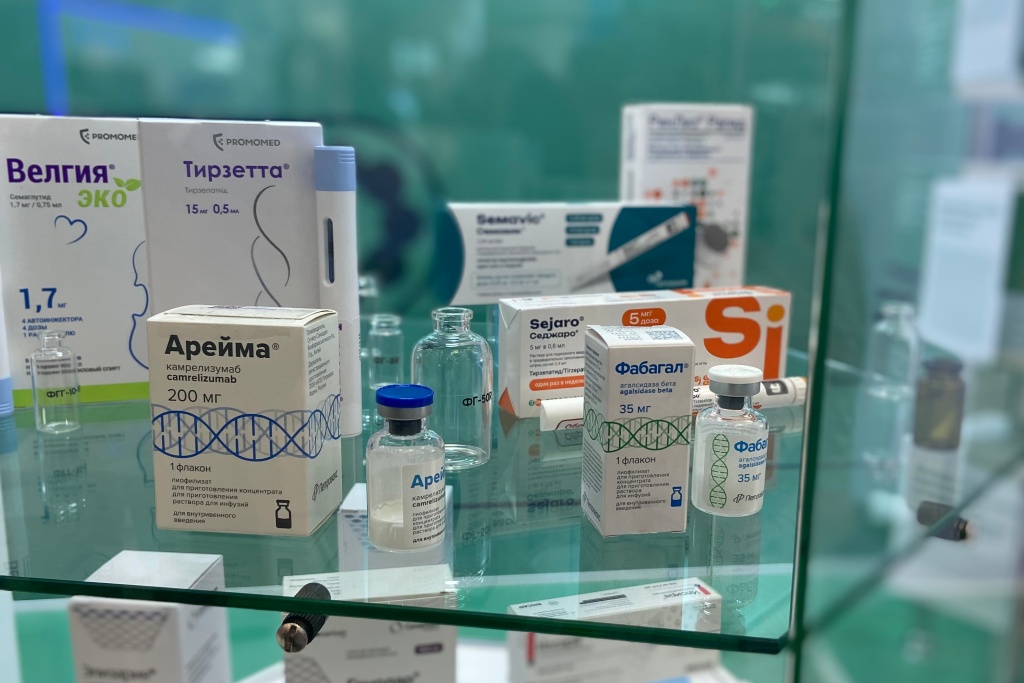
At the joint exhibition organized by the Ministry of Industry and Trade, Petrovax Pharm showcased two flagship biotechnological products: Fabagal® (agalsidase beta) for the treatment of the rare Fabry disease and Areyma® (camrelizumab) for the treatment of esophageal and nasopharyngeal cancers.
Mikhail Tsyferov, President of Petrovax Pharm, took an active part in the forum, speaking at the sessions "Vectors for Creating Innovations and Their Role in the Healthcare System" and "Strategy for Technological Leadership in Russia and MedBioPharma: Priority Projects for 2026". Discussions focused on key issues related to achieving technological leadership in the Russian pharmaceutical industry and improving patient access to biotechnological medicines.
Breakthrough therapies enhance treatment outcomes and open new opportunities, but they require substantial investment—making the improvement of innovation accessibility a crucial task for Russia.
According to Mikhail Murashko, Minister of Health of the Russian Federation, the national project "New Technologies for Health Preservation" envisions the development of 186 medicinal products and 368 medical devices in the country. To achieve these ambitious goals, regulatory mechanisms alone are not enough—support for individual developments must begin as early as the clinical trial planning stage. The Minister stressed that efficacy and safety are inseparable, and innovation must stay under careful state supervision — ensuring that, while no harm is done, truly effective solutions reach those who need them.
Although Russian pharmaceutical companies are capable of producing high-quality biotechnological medicines at competitive prices, the introduction of innovations into practice often takes years.
When bringing advanced technologies to market, domestic manufacturers face various barriers, explained Mikhail Tsyferov, President of Petrovax Pharm. These include long timelines for inclusion of medicines in essential drug lists/formularies, DRG (Diagnosis-Related Groups), clinical guidelines, and the state reimbursement program. As a result, innovative medicines of foreign origin still account for a significant share of public procurement.
For example, the procurement prospects for the breakthrough immuno-oncology drug camrelizumab next year remain uncertain, despite its recommendation for inclusion in the Essential Drug List. Although it costs 30% less than comparable products, its wide clinical use requires inclusion in DRG and state reimbursement programs. Consequently, even though the full production cycle of camrelizumab is localized at Petrovax Pharm facilities, patients will realistically gain access to the drug only in 1–2 years, despite the potential savings for the national healthcare budget.
Mr. Tsyferov also emphasized that innovations do not necessarily increase treatment costs—on the contrary, they can generate significant budget savings.
For instance, Petrovax Pharm localized and launched the orphan enzyme replacement therapy drug agalsidase beta for Fabry disease, capturing half of the market within two years without any government support. The therapy is competitively priced, being 40% less expensive than the imported analogue. The remaining market share is held by another molecule, agalsidase alpha, which continues to be procured despite offering no price or efficacy advantage (notably, this molecule is not registered in the United State). The Russian agalsidase beta is now undergoing authorization in Kazakhstan and Azerbaijan, with interest also expressed by Vietnam.
Barriers to introducing domestic medicines into clinical practice were also highlighted by Timofei Nizhegorodtsev, Deputy Head of the Federal Antimonopoly Service of Russia. He noted that the integration of Russian innovative drugs is hindered by clinical guidelines, which are updated every 3–5 years. Until a drug is included in these guidelines, it cannot be added to the state reimbursement program. However, even annual updates would still lag behind the pace of innovation, the expert argued.
To address this issue, Mr. Tsyferov proposed introducing a priority pathway for including original medicines developed and manufactured by Russian companies into essential drug lists/formularies and clinical guidelines, synchronized with their inclusion in DRG. This approach would help the state save budget funds while enabling domestic manufacturers to recoup investments faster and reinvest in new innovative projects.
Experts concluded that despite the challenging geopolitical environment, the market for Russian pharmaceutical and medical innovations continues to advance. However, the challenges that arise along the way must be addressed swiftly.
Chronic pain and infertility: why endometriosis requires a comprehensive approach to therapy