Chronic pain and infertility: why endometriosis requires a comprehensive approach to therapy
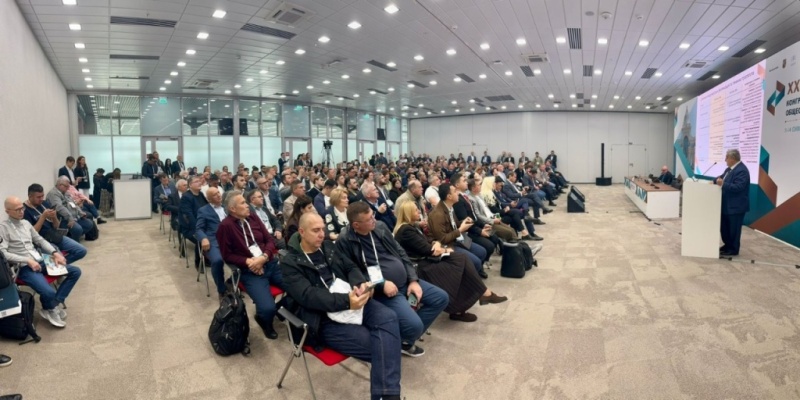
Endometriosis is a condition affecting one in ten women worldwide[1]. The disease significantly reduces quality of life: 6 out of 10 women experience severe pain, and 30-50% face difficulties conceiving[2]. The importance of a comprehensive approach to treating this disease is evident, and experts shared their experience in its implementation at the 26th All-Russian Forum "Mother and Child".
According to the World Health Organization, more than 190 million women of reproductive age suffer from endometriosis[3]. The main clinical manifestations of the disease include infertility, pregnancy loss, menstrual cycle disorders including amenorrhea or heavy menstrual bleeding, as well as pronounced pain syndrome.
The development of endometriosis is accompanied by a chronic inflammatory reaction associated with the presence of large amounts of low-molecular-weight hyaluronic acid, which fosters the initiation of fibrotic processes and adhesion formation, as well as additionally stimulates inflammation.
More than 60% of patients suffer from pain associated with endometriosis[6]. Pain syndrome not only reduces quality of life but can also cause anxiety disorders and depressive states[7].
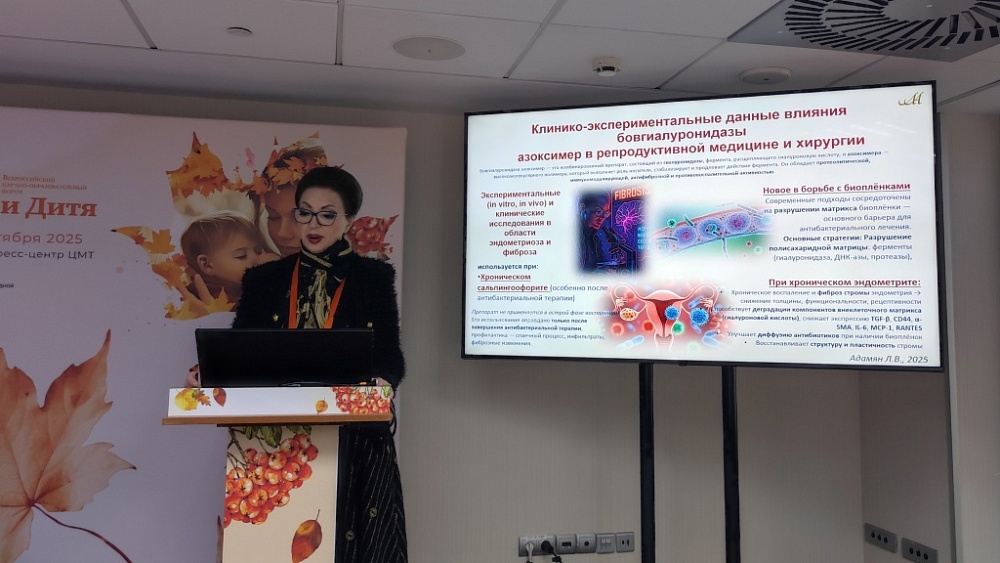
Endometriosis requires comprehensive therapy, including the use of drugs capable of affecting the intensity of the adhesive process and the level of inflammation. Bovhyaluronidase azoximer (Longidaza®) possesses such properties; it does not damage healthy connective tissue, regulates the synthesis of inflammatory mediators, and exerts an antifibrotic effect.
Bovhyaluronidase azoximer is also an important tool in combating biofilms, structures that aggregate large numbers of microorganisms and significantly increase their survival.
The problem of biofilm formation in gynecology is widespread: from 52% to 96.7% of pelvic inflammatory diseases are accompanied by their formation. Bacteria within biofilms survive in the presence of high concentrations of antibiotics, which complicates the fight against inflammation. Chronic inflammation can provoke chronic pelvic pain and stimulate adhesive processes[9]. Therefore, biofilm destruction is a key factor in effective therapy of inflammatory diseases.
Studies show that bovhyaluronidase azoximer reduces biofilm biomass and increases the effectiveness of antibiotic therapy while reducing the concentration of antimicrobial drugs used[10]. It has been studied in more than 140 studies. The drug has been used in clinical practice for over 20 years, treating more than 3.5 million patients.
She emphasized that therapeutic success requires a combined approach: an antibiotic together with agents that disrupt the biofilm matrix, particularly hyaluronidase-based drugs.
Chronic inflammation and biofilms present a significant barrier to achieving pregnancy. Treatment of chronic endometritis plays a critical role in supporting reproductive function, as even a high-quality embryo cannot implant if the endometrium is affected by persistent inflammation and biofilms, explained Natalia Igorevna Tapilskaya, Doctor of Medical Sciences, Professor and Head of the Gynecology and Endocrinology Department at the D.O. Ott Research Institute of Obstetrics, Gynecology, and Reproductive Medicine, and Professor of Obstetrics and Gynecology at St. Petersburg State Pavlov Medical University. She emphasized that restoring full endometrial receptivity requires combining antibiotics with adjuvant therapies capable of disrupting biofilms.
1 World Health Organization. Endometriosis. https://www.who.int/ru/news-room/fact-sheets/detail/endometriosis
2 Mathyk, Begum Aydogan et al. “Beyond the surface: Does stage I-II endometriosis impact fertility? Exploring the challenges of mild disease.” Best practice & research. Clinical obstetrics & gynaecology vol. 96 (2024): 102501. doi:10.1016/j.bpobgyn.2024.102501.
3 Horne, Andrew W, and Stacey A Missmer. “Pathophysiology, diagnosis, and management of endometriosis.” BMJ (Clinical research ed.) vol. 379 e070750. 14 Nov. 2022, doi:10.1136/bmj-2022-070750.
4 Somigliana, Edgardo et al. “Adhesion prevention in endometriosis: a neglected critical challenge.” Journal of minimally invasive gynecology vol. 19,4 (2012): 415-21. doi:10.1016/j.jmig.2012.03.004.
5 Kareva E. N., Donskov S. V. Hyaluronic acid and hyaluronidase: from molecular mechanisms to clinical application. Gynecology, 2025, Vol. 27, No. 2, pp. 157–171 (in Russian).
6 Adamyan L. V., Pivazyan L. G., Kurbatova K. S., et al. Objectification of pain in patients with endometriosis (Literature review and own data). Problems of Reproduction. 2025;31(2):62‑85 (in Russian).
7 Dereje G. Gete, Jenny Doust, Sally Mortlock, Grant Montgomery, Gita D. Mishra,Impact of endometriosis on women's health-related quality of life: A national prospective cohort study, Maturitas, Volume 174, 2023, Pages 1-7, ISSN 0378-5122, doi: 10.1016/j.maturitas.2023.04.272.
8 Yarmolinskaya MI, Radzinsky VE, Orazov MR, Korotkikh IN, Ziganshin OR, Eremina NA, Khobets VV. Evaluation of the efficacy of bovhyaluronidase azoximer in the combined treatment of patients with external genital endometriosis based on the results of a multicenter prospective non-interventional study (ISLAND). Gynecology. 2021;23(5):392–400 (in Russian).
9 Kalinkina OB, Tezikov YV, Lipatov IS, Aravina OR. Non-invasive therapy of adhesive disease in women with tubal-peritoneal infertility after inflammatory pelvic diseases. Modern Issues of Science and Education. 2016;(6) (in Russian).
10 Rossolovskaya KA, Trifonova NS, Ishchenko AI, Gadaeva IV, Bragina EE, Boldyreva MN, Moskvina ZV, Spivak LG. Efficacy and safety of enzymatic hydrolysis in the complex treatment of bacterial vaginosis: preliminary results of a clinical study. Gynecology, Obstetrics and Perinatology. 2025; 24(2): 88–96. DOI: 10.20953/ 1726-1678-2025-2-88-96 (in Russian).